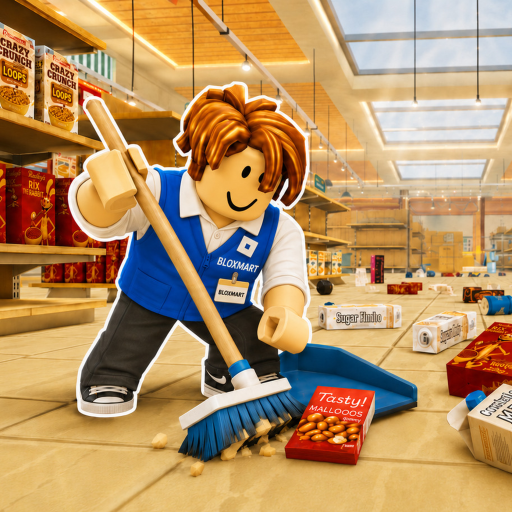
1. Fill shelves
Every completed shelf pays points. Throughput is income: nearby partial shelves first, one aisle at a time.
The Clean The Superstore economy is one loop: fill shelves for points, spend points on abilities, repeat — with an optional Robux pass catalog alongside. This page plans the decisions that loop actually requires, using documented facts checked 2026-10-03.
Points come from filled shelves and are the game's only documented currency. They buy four abilities — Scanner, Magnet, Shelf Finder, Auto Stock — in the upgrades menu (press G). Buy them in the community order (Scanner first) rather than by memorized price, because point prices are shown in-game and change between updates. Robux passes exist (49–1,199 Robux, seven of them) but none is required: 830,491 players hold the 100% badge without needing any.
One currency, one sink — the whole economy fits in four steps.
Every completed shelf pays points. Throughput is income: nearby partial shelves first, one aisle at a time.
The 25%, 50%, and 100% badges mark natural spending checkpoints — re-invest points at each before pushing on.
Press G for the upgrades menu. Four abilities, prices shown live in-game, bought in the community order.
Each purchase removes time from every later placement, so income compounds: Scanner pays per placement, Magnet per trip.
Effects documented from creator demo footage via the community wiki; order is the community's recommended purchase sequence, checked 2026-10-03.
| Buy order | Ability | Effect | Pays back on | Source |
|---|---|---|---|---|
| 1 | Scanner | Highlights where the item you are holding belongs. | New players and unfamiliar shelves — it removes the sign-matching guesswork per item. | Community wiki (creator demo footage, July 26, 2026) |
| 2 | Magnet | Pulls nearby misplaced items toward you. | Cutting walk time in messy aisles; pairs well with finishing partial shelves. | Community wiki (creator demo footage, July 26, 2026) |
| 3 | Shelf Finder | Locates shelves that still need stock. | Large maps (Mall, Megastore) where scanning for gaps wastes the most time. | Community wiki (creator demo footage, July 26, 2026) |
| 4 | Auto Stock | Automates stocking for you. | Late-run throughput once you can afford it; the community wiki lists it last in the purchase order. | Community wiki (creator demo footage, July 26, 2026) |
The community wiki's recommended purchase order (Scanner first, then Magnet → Shelf Finder → Auto Stock) follows each ability's cost-to-impact: Scanner fixes per-item targeting immediately, Magnet and Shelf Finder cut travel, and Auto Stock is the late-game throughput capstone. Point costs are shown inside the game's own upgrades menu and change with updates, so this site links the decision instead of quoting stale prices.
Seven passes at 49–1,199 Robux per the community wiki's catalog check (September 25, 2026). None of them is required to finish the store — the 100% badge has hundreds of thousands of awards from free-to-play runs — but carry capacity and speed passes compress the same travel time this site's calculators estimate.
| Pass | Price | What it overlaps in the free economy |
|---|---|---|
| Starter Pack | 49 Robux | General throughput — the point abilities reach the same goal. |
| +5 Carry | 49 Robux | Carrying more per trip — batching trips does part of this free. |
| Max Speed | 89 Robux | Travel time — routing and aisle discipline recover much of it free. |
| +15 Carry | 129 Robux | Carrying more per trip — batching trips does part of this free. |
| Unlimited Power | 699 Robux | Power/throughput — overlaps the Auto Stock endgame purchase. |
| Infinite Magnet Range | 699 Robux | Magnet reach — the point-bought Magnet covers the same idea at shorter range. |
| Lifetime Helper | 1,199 Robux | General throughput — the point abilities reach the same goal. |
Catalog from the community wiki (checked September 25, 2026); overlap analysis is this site's planning advice.
Three planning moves that survive every balance patch.
The game shows the reward as you complete each shelf, but no public source documents a fixed rate — the official description only establishes that points come from filling shelves, and the point prices live in the game's upgrades menu where they change between updates. This planner deliberately does not quote per-shelf or per-ability numbers it cannot check; read them off your own G menu, which is always current.
Four documented abilities: Scanner (highlights where your held item belongs), Magnet (pulls nearby mess to you), Shelf Finder (locates shelves that need stock), and Auto Stock (automates stocking). The community-recommended purchase order is Scanner → Magnet → Shelf Finder → Auto Stock.
Ability point costs are displayed in the game's own upgrades menu and move with updates, so any fixed cost table would go stale. Buy by the documented order instead — it holds even when prices shift, because it is based on each ability's impact per placement, not its price.
They compress time, they are not progress gates. The seven passes (49–1,199 Robux) cover carry capacity, speed, and magnet range — categories the point upgrades also reach. With 830,491 players holding the 100% completion badge, free-to-play completion is clearly the norm; passes mostly matter if you are chasing the timed badges.
Not from public data. The honest inputs — per-shelf point rates and per-ability prices — are only stable inside a single game update, and the developer changes them. What this page can plan is the decision order (which ability next, which milestone to recheck) and the pace math that tells you whether your income rate is on track.
None documented. Points are the only currency the official description mentions, and the game has no code redemption system as of the 2026-10-03 check — the codes page covers what was verified and why look-alike lists do not apply.
Scale for context: the official description counts over 3,000 misplaced items on the CleanTogether experience (live title 🏪[8K+ MEGASTORE] Clean The Superstore!, checked 2026-10-03). Sources and dates for every figure are registered on the sources page.