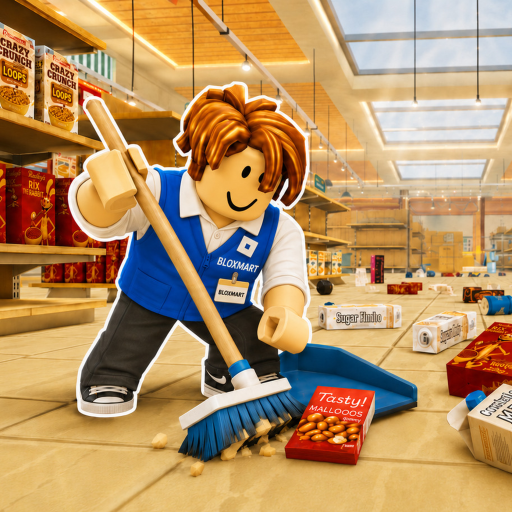
Finish partial shelves first
A shelf needing two products is the best point-per-minute target in the store. Before starting an empty shelf, scan for nearly-full ones in your current aisle and cash them in.
Treat shelf completion as the repeatable point loop: finish nearby partial shelves, cut travel, buy the abilities that remove seconds from every placement, and measure the result against the official badge windows. Checked 2026-10-03.
Farming in Clean The Superstore is throughput, not speed: finish nearby partial shelves before starting empty ones, clear one aisle at a time in one direction, give any mystery item ten seconds then drop it with Q, and spend points on Scanner then Magnet so every placement and every trip gets cheaper. Recheck your pace at the 25% and 50% milestones — projected finish = elapsed ÷ (completion ÷ 100).
Each rule attacks one of the three real time costs: walking, deciding, and placing.
A shelf needing two products is the best point-per-minute target in the store. Before starting an empty shelf, scan for nearly-full ones in your current aisle and cash them in.
Work the store like a checkerboard: one aisle at a time, no crisscrossing. Finished aisles stop generating travel, and you always know which direction the next unfinished shelf is.
Sign, cycle, one attempt, then drop with Q. Mystery items are cheaper to abandon than to camp; most resolve themselves when you return with a different held product.
Carry everything near the target shelf before placing. Even without carry upgrades, two full-handed trips beat six single-item errands across the same distance.
Spend points where they remove seconds from every placement: Scanner first, Magnet second. Ability prices live in the upgrades menu (G) and change between updates — buy by order, not by memory.
At 25% and 50%, compare elapsed time against the badge windows. Projected finish = elapsed ÷ (completion ÷ 100). A projection above 120 minutes means the issue is routing, not effort.
Derived from the official badge windows (Roblox Badges API goal text, checked 2026-10-03); pace lines are arithmetic, not game guarantees.
| Run type | Average pace needed | Mid-run check | Reality check |
|---|---|---|---|
| Casual Cleaner (under 120 min) | ≥ 0.84 pts/min | 45% by minute 54 | 22,291 awards — most full-store runners land here or slower. |
| Comfortable finish (2–3 hours, untimed) | 0.55–0.83 pts/min | 25% by minute 45 | The 100% badge's 830,491 awards mostly come from untimed runs like this. |
| Speed Cleaner (under 60 min) | ≥ 1.67 pts/min | 45% by minute 27 | 278 awards. Elite: only 0.0038% of players who ever joined. Demands every efficiency rule at once. |
How to read it: pace is completion percentage per minute averaged over the run (100 ÷ 60 ≈ 1.67 for the hour badge, 100 ÷ 120 ≈ 0.84 for the two-hour badge). The mid-run check is the completion you should have at a given minute — 45% completion at 30 minutes elapsed projects to 30 ÷ 0.45 ≈ 67 minutes, which is the Speed window's wall.
Community-documented layouts — creator video tours, checked 2026-10-03; the game itself publishes no atlas.
| Map | Era | Layout as documented | Efficiency focus |
|---|---|---|---|
| Original Superstore | Launch map (June 2026) | Single-floor supermarket aisles; the loop that the 3,000+ item description was written for. | Aisle discipline: one direction, batched trips. |
| Mall (NEW MAP) | Shipped in the [NEW MAP] era | Two floors. Community video tours document Floor 2 zones: Jewellery, Clothing, Cinema, Beauty; a Furniture zone appears in footage but its exact placement still varies between videos. | Vertical routing: finish one floor's partials before switching. |
| 8K+ Megastore | Current title tag (September 2026) | The Megastore update expanded the store scale advertised in the title; full zone-by-zone documentation lives in creator walkthroughs rather than any official source. | Gap-finding: Shelf Finder pays before Magnet. |
| Store2 | Reported subplace | A public place profile reported Store2 under CleanTogether during the NEW MAP era. It is an infrastructure signal (Roblox places can hold staging subplaces), and no public source documents its contents. | Aisle discipline: one direction, batched trips. |
Sources per row on the sources page; the Mall's Floor 2 zones (Jewellery, Clothing, Cinema, Beauty) come from creator tours. The map and systems wiki page covers the layout history in full.
Highlights where the item you are holding belongs.
New players and unfamiliar shelves — it removes the sign-matching guesswork per item.
Pulls nearby misplaced items toward you.
Cutting walk time in messy aisles; pairs well with finishing partial shelves.
Locates shelves that still need stock.
Large maps (Mall, Megastore) where scanning for gaps wastes the most time.
Automates stocking for you.
Late-run throughput once you can afford it; the community wiki lists it last in the purchase order.
Complete shelves steadily near your current position. Points come from filled shelves (official description), so throughput — shelves per hour — beats any single fast placement. Finishing a nearly-complete shelf pays the same as starting an empty one from farther away, which is why partial-shelf finishing is the core of the efficiency route.
In the community's purchase order (Scanner → Magnet → Shelf Finder → Auto Stock), Scanner pays first because it removes per-item targeting pauses, and Magnet pays second by shrinking walking. Shelf Finder and Auto Stock matter more on the big current maps, where finding gaps visually takes the longest.
Give any single item a ten-second budget: check the sign, cycle to it, try once. If it has no clear home, press Q and move on — one mystery product should never hold a whole aisle's throughput hostage. The item helper page covers the sign-and-shelf method for the stubborn ones.
Yes, by scale. The launch superstore's aisles are compact enough that walking is a minor cost; the two-floor Mall adds vertical travel; the current 8K+ Megastore pushes gap-finding — not carrying — into the top cost, which is where Shelf Finder earns its price. Map layouts are documented from community video tours, not an official atlas.
Note completion percentage at fixed times — 10, 20, and 30 minutes — and compare runs. Projected finish = elapsed ÷ (completion ÷ 100); if the projection drops between runs, your routing improved. The calculator does this math and checks it against the official 60- and 120-minute badge windows.
Per player-hour, a coordinated group clears more: the description endorses teaming up to finish faster, and servers hold 12. The catch is coordination cost — an unorganized group duplicates searches and can be slower than one practiced solo cleaner. The squad planner exists to fix exactly that.
Turn elapsed time and completion into a projected finish and a verdict.
Split aisles in a group run without duplicating searches.
The sign-and-shelf method for products that refuse to match.